Updated
|
How Technology Transforms Education in 2025
Explore how technology shapes learning today, with updated data, policy context, trends, and real-world implications for students, educators, and families.

The Role of Technology in Education

Technology has reshaped education over the past decade, moving from supplemental tools to central components of teaching and learning. In 2025, digital tools, platforms, and artificial intelligence (AI) are influencing how educational content is delivered, accessed, and assessed for students from kindergarten through higher education. This article explores current trends, evidence, policy considerations, and the implications for parents, students, educators, and policymakers.

The Evolution of Educational Technology

Education technology, or EdTech, refers to the digital systems used to support instruction, learning, assessment, and administration. Initially limited to basic computer labs and projectors, technology in education now includes cloud-based platforms, adaptive learning systems, virtual and augmented reality, and generative AI tools.

The global EdTech market continues to expand rapidly, underscored by sustained investment and adoption. In 2025, the global market was valued at approximately $233.8 billion, with projections suggesting continued growth into the next decade. This expansion reflects increasing demand for online learning, mobile apps, and AI-enabled solutions in schools and universities around the world. Global Growth Insights

How Students and Teachers Use Technology

Classroom and remote learning environments now rely on a diverse ecosystem of technologies. A large majority of educators use digital tools in daily instruction, while students engage with technology for collaboration, research, and assessment.

Recent data indicate that nearly all teachers incorporate some form of digital resource in their classrooms, with many employing interactive lessons and platforms that

. . .read more

School Uniforms Debate in 2026: Evidence, Costs, Outcomes

Updated
|
School Uniforms Debate in 2026: Evidence, Costs, Outcomes
Explore the updated 2025 debate on school uniforms with current research, policy shifts, cost concerns, student experience, and global perspectives.

School Uniforms: The Raging Debate in 2026

School uniforms remain one of the most debated policies in education. Supporters argue uniforms promote discipline and equity, while critics say they burden families, restrict expression, and offer limited academic benefits. This updated analysis uses the latest data and research to help parents, educators, students, and policymakers understand the complex trade-offs involved.

What School Uniforms Are and How Widespread They Are

A school uniform is a standardized set of clothing required by a school that usually includes specified shirts, trousers or skirts, and often ties or blazers. Students may attend schools with strict dress codes, partial uniform requirements, or no formal uniform at all. Uniforms are common in many countries across Africa, Asia, and Oceania, but less so in the United States and much of continental Europe.

According to recent reviews, about one in five U.S. public schools requires uniforms in some form, with adoption highest in elementary levels and lower in high schools. Globally, uniform policies vary widely by culture and education system.

Historical Roots of Uniform Policies

The idea of standard dress in schools dates back centuries, with some of the earliest modern examples traced to 16th-century England. In the U.S., uniform policies gained attention in the late 20th century as public schools sought ways to improve safety and focus on learning.

Arguments in Favor of School Uniforms

Promoting Safety and

. . .read more

The Push for Bilingual Education in 2025

Updated
|
The Push for Bilingual Education in 2025
Explore current research, policy updates, demographics, and classroom outcomes in bilingual education for parents, educators, and policymakers.

The Push for Bilingual Education in 2025

Bilingual education continues to be one of the most debated and dynamic areas of U.S. public education policy. As the nation’s student population becomes more linguistically diverse, families, educators, and policymakers are re-examining how schools can best support bilingual education to meet academic, cultural, and economic goals. This article updates key trends, research findings, policy changes, and real-world examples from the most recent data available in 2025, helping families and decision makers understand the state of bilingual learning today.

What Is Bilingual Education?

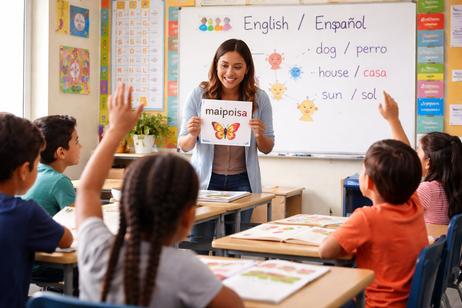
Bilingual education refers to instructional approaches in which students learn academic content in two languages, typically English and a partner language, such as Spanish, Mandarin, or American Sign Language. These programs vary widely in design. Some offer support for students learning English, others aim for biliteracy for all students regardless of background, and still others, like dual-language immersion, share instructional time more equitably across languages.

Bilingual education can include:

  • Transitional bilingual programs designed primarily to support English learners’ acquisition of English language skills

  • Dual-language immersion programs that aim for literacy and academic proficiency in both languages

  • Developmental bilingual programs that support heritage language maintenance while students gain English proficiency

A directory of current foreign language immersion offerings illustrates the variety of programs available in U.S. schools, including Spanish-English immersion programs in multiple states. Public School

. . .read more

Public School Open House & Enrollment Season Guide for Parents

Warning: mkdir(): Permission denied in /home/devmiha/workspace/psr/public_html/include/srn_lib/psr/misc/QuickPhotos.inc.php on line 24 Warning: mkdir(): Permission denied in /home/devmiha/workspace/psr/public_html/include/srn_lib/psr/misc/QuickPhotos.inc.php on line 24 Warning: mkdir(): Permission denied in /home/devmiha/workspace/psr/public_html/include/srn_lib/psr/misc/QuickPhotos.inc.php on line 24 Warning: mkdir(): Permission denied in /home/devmiha/workspace/psr/public_html/include/srn_lib/psr/misc/QuickPhotos.inc.php on line 24
Updated
|
Public School Open House & Enrollment Season Guide for Parents
Learn what to ask at a public school open house during enrollment season, from academics to safety, to choose the right school for your child.

Public School Open House & Enrollment Season: What Parents Should Ask

Public school open house season is one of the most important times of year for families. Whether you are enrolling a kindergartener, transitioning to middle school, or considering a high school option, a public school open house offers a valuable opportunity to see classrooms, meet educators, and evaluate whether a school is the right fit for your child.

In 2025, public school enrollment continues to evolve. Districts are expanding magnet programs, investing in social emotional learning, and responding to parent demand for transparency around safety, academics, and student outcomes. A well planned visit to a public school open house can help families cut through marketing language and gather meaningful insights.

This guide outlines what parents should ask during a public school open house and enrollment season, how to prepare in advance, and how to compare schools effectively.

Why Public School Open House Season Matters

A public school open house is more than a tour. It is often the only chance to observe how a school operates during the academic year. During public school open house events, families can see class sizes, review curriculum materials, and assess school culture in person.

Enrollment decisions made during public school open house season often determine access to specialized programs, transportation eligibility, and extracurricular opportunities. Missing key information can limit options later.

According to data shared by the National Center for Education Statistics, family

. . .read more

School Zoning Changes 2026: How Assignments May Shift

Warning: mkdir(): Permission denied in /home/devmiha/workspace/psr/public_html/include/srn_lib/psr/misc/QuickPhotos.inc.php on line 24 Warning: mkdir(): Permission denied in /home/devmiha/workspace/psr/public_html/include/srn_lib/psr/misc/QuickPhotos.inc.php on line 24 Warning: mkdir(): Permission denied in /home/devmiha/workspace/psr/public_html/include/srn_lib/psr/misc/QuickPhotos.inc.php on line 24 Warning: mkdir(): Permission denied in /home/devmiha/workspace/psr/public_html/include/srn_lib/psr/misc/QuickPhotos.inc.php on line 24
Updated
|
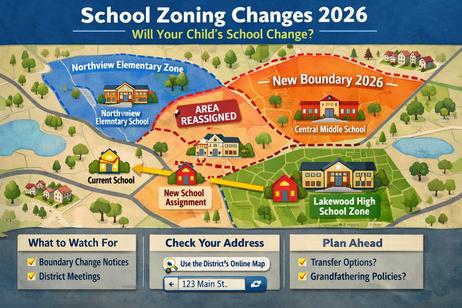
School Zoning Changes 2026: How Assignments May Shift
School Zoning Changes 2026 could affect your child’s school assignment. Learn how zoning works, what is changing, and how families can prepare.

School Zoning Changes 2026: How to Know if It Affects Your Child’s Assignment

School zoning determines which public school a child is assigned to based on where a family lives. For many households, zoning decisions shape daily routines, home values, academic options, and long-term educational planning. As districts across the country prepare for School Zoning Changes 2026, families are asking an urgent question: will these changes affect my child’s school assignment?

School Zoning Changes 2026 are being driven by enrollment shifts, housing development, capacity imbalances, and equity initiatives. While zoning updates are routine, the scale of proposed adjustments in 2026 has elevated concerns among parents, educators, and policymakers. Understanding how School Zoning Changes 2026 work, where they are happening, and what steps families should take can help reduce uncertainty and protect educational continuity.

This guide explains School Zoning Changes 2026 in clear terms, outlines warning signs that your assignment may change, and provides practical steps families can take now.

What Are School Zoning Changes 2026

School zoning refers to geographic attendance boundaries established by public school districts. These boundaries determine which elementary, middle, or high school a student attends by default. School Zoning Changes 2026 involve district-approved updates to these boundaries that take effect during the 2026 academic year.

School Zoning Changes 2026 are not random. They are typically the result of long-term planning cycles that account for:

  • Population growth or decline

. . .read more

Recent Articles

Spring Parent-Teacher Conferences: Key Questions
Spring Parent-Teacher Conferences: Questions Every Parent Should Ask to support academic growth, social development, and 2026 classroom goals.
Prepare for Spring Tests Without Anxiety
Learn how to prepare for spring standardized tests without increasing anxiety using proven strategies for families and schools.
Why Public Schools Are Launching Marketing Campaigns in 2026
Discover why public schools are launching marketing campaigns in 2026 and how enrollment shifts, school choice, and funding pressures are driving change.
Notice: Javascript file does not exist: /home/devmiha/workspace/psr/public_html/javascript/components/popper.min.js in /home/devmiha/workspace/shared/misc/JSCompiler.inc.php on line 241 Notice: Javascript file does not exist: /home/devmiha/workspace/psr/public_html/javascript/components/tippy.min.js in /home/devmiha/workspace/shared/misc/JSCompiler.inc.php on line 241 Notice: Directory does not exist in /home/devmiha/workspace/shared/misc/JSCompiler.inc.php on line 241 Notice: Unable to save compiled js file in /home/devmiha/workspace/shared/misc/JSCompiler.inc.php on line 241