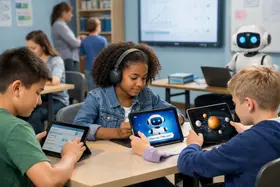
Cooperative learning is a successful teaching strategy in which small teams, each with students of different levels of ability, use a variety of learning activities to improve their understanding of a subject. Each member of a team is responsible not only for learning what is taught but also for helping teammates learn, thus creating an atmosphere of achievement. Students work through the assignment until all group members successfully understand and complete it.
Cooperative efforts result in participants striving for mutual benefit so that all group members:
- gain from each other's efforts.
- recognize that all group members share a common fate.
- know that one's performance is mutually caused by oneself and one's team members.
- feel proud and jointly celebrate when a group member is recognized for achievement.
This video illustrates the team model of learning.
Why use Cooperative Learning?
Research has shown that cooperative learning techniques:
- promote student learning and academic achievement
- increase student retention
- enhance student satisfaction with their learning experience
- help students develop skills in oral communication
- develop students' social skills
- promote student self-esteem
- help to promote positive race relations
5 Elements of Cooperative Learning
It is only under certain conditions that cooperative efforts may be expected to be more productive than competitive and individualistic efforts.
Those conditions are:
Those conditions are:
1. Positive Interdependence (sink or swim together)
- Each group member's efforts are required and indispensable for group success
- Each group member has a unique contribution to make to the joint effort because of his or her resources and/or role and task responsibilities
2. Face-to-Face Interaction (promote each other's success)
- Orally explaining how to solve problems
- Teaching one's knowledge to other
- Checking for understanding
- Discussing concepts being learned
- Connecting present with past learning
3. Individual & Group Accountability ( no hitchhiking! no social loafing)
- Keeping the size of the group small. The smaller the size of the group, the greater the individual accountability may be.
- Giving an individual test to each student.
- Randomly examining students orally by calling on one student to present his or her group's work to the teacher (in the presence of the group) or to the entire class.
- Observing each group and recording the frequency with which each member contributes to the group's work.
- Assigning one student in each group the role of a checker. The checker asks other group members to explain the reasoning and rationale underlying group answers.
- Having students teach what they learned to someone else.
4. Interpersonal & Small-Group Skills
- Leadership
- Decision-making
- Trust-building
- Communication
- Conflict-management skills
5. Group Processing
- Group members discuss how well they are achieving their goals and maintaining effective working relationships
- Describe what member actions are helpful and not helpful
- Make decisions about what behaviors to continue or change
Class Activities that use Cooperative Learning
Most of these structures are developed by Dr. Spencer Kagan and his associates at Kagan Publishing and Professional Development. For resources and professional development information on Kagan Structures, please visit: www.KaganOnline.com
1. Jigsaw
1. Jigsaw
- Groups with five students are set up. Each group member is assigned some unique material to learn and then to teach to his group members. To help in the learning students across the class working on the same sub-section get together to decide what is important and how to teach it. After practice in these "expert" groups, the original groups reform, and students teach each other.
This video explains the jigsaw method of learning.
2. Think-Pair-Share- Involves a three-step cooperative structure. During the first step, individuals think silently about a question posed by the instructor. Individuals pair up during the second step and exchange thoughts. In the third step, the pairs share their responses with other pairs, other teams, or the entire group.
This video explains Think Pair Share.
3. Three-Step Interview (Kagan)- Each member of a team chooses another member to be a partner. During the first step, individuals interview their partners by asking clarifying questions. During the second step, partners reverse the roles. For the final step, members share their partner's response with the team.
- The class is divided into small groups (4 to 6) with one person appointed as the recorder. A question is posed with many answers and students are given time to think about answers. After the "think time," members of the team share responses with one another round-robin style. The recorder writes down the answers of the group members. The person next to the recorder starts and each person in the group in order gives an answer until the time is called.
- Teachers stop any time during a lecture or discussion and give teams three minutes to review what has been said, ask clarifying questions, or answer questions.
- A team of four is established. Each member is given numbers of 1, 2, 3, 4. Questions are asked of the group. Groups work together to answer the question so that all can verbally answer the question. The teacher calls out a number (two) and each two is asked to give the answer.
- Students do problems first as a team, then with a partner, and finally on their own. It is designed to motivate students to tackle and succeed at problems that initially are beyond their ability. It is based on a simple notion of mediated learning. Students can do more things with help (mediation) than they can do alone. By allowing them to work on problems they could not do alone, first as a team and then with a partner, they progress to a point they can do alone that which at first they could do only with help.
- First, the teacher polls the class to see which students have special knowledge to share. For example, the teacher may ask who in the class was able to solve a difficult math homework question, who had visited Mexico, who knows the chemical reactions involved in how salting the streets help dissipate snow. Those students (the sages) stand and spread out in the room. The teacher then has the rest of the classmates each surround a sage, with no two members of the same team going to the same sage. The sage explains what they know while the classmates listen, ask questions, and take notes. All students then return to their teams. Each in turn, explains what they learned. Because each one has gone to a different sage, they compare notes. If there is disagreement, they stand up as a team. Finally, the disagreements are aired and resolved.
- The class is divided into teams of four. Partners move to one side of the room. Half of each team is given the assignment to master to be able to teach the other half. Partners work to learn and can consult with other partners working on the same material. Teams go back together with each set of partners teaching the other set. Partners quiz and tutor teammates. The team reviews how well they learned and taught and how they might improve the process.
Questions? Contact us on Facebook. @publicschoolreview